
NYC Sliver Law Changes: Which Zoning Districts Are No Longer Affected?
Updated: Sep 9
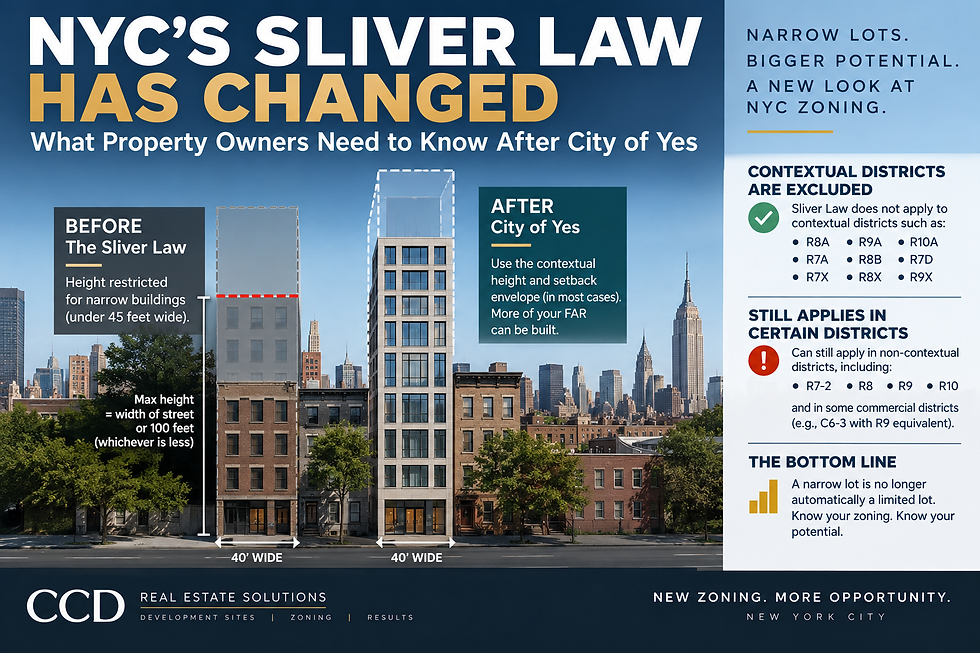
For decades, New York City's Sliver Law created a major problem for certain narrow development sites.
A property could have significant unused FAR, but if the building was too narrow (less than 45 feet), zoning could severely restrict how high it could be built.
In simple terms:
You could have the FAR — but not enough height to actually use it.
NYC's City of Yes for Housing Opportunity, adopted in December 2024, significantly changed that.
Most importantly, the current Sliver Law does not apply to contextual zoning districts such as R8A or R9A. This can make a major difference when analyzing narrow NYC development sites.
What Is the NYC Sliver Law?
The Sliver Law was created in the 1980s to prevent extremely tall, narrow buildings.
Under NYC Zoning Resolution §23-738, certain portions of buildings with street walls less than 45 feet wide can be subject to special height restrictions.
For a typical interior lot, the height can be limited to the width of the street or 100 feet, whichever is less.
This could prevent a narrow development site from utilizing all of its permitted FAR.
Which Zoning Districts Does the Sliver Law Apply To Today?
This is where the December 2024 zoning changes are particularly important.
The current ZR §23-738 specifically identifies only:
R7-2
R8
R9
R10
Notice what's missing.
Contextual zoning districts with letter suffixes are not listed. Contextual zoning are those with a letter suffix.
For example, §23-738 does not list:
R7A, R7D, R7X, R8A, R8B, R8X, R9A, R9X or R10A.
These are contextual districts with their own height-and-setback rules.
Therefore, a property being less than 45 feet wide does not automatically trigger the Sliver
Law simply because it is located in a high-density zoning district.
The exact zoning district matters.
City of Yes Specifically Removed the Sliver Law From Contextual Zoning
This wasn't accidental.
As part of City of Yes, the NYC Department of City Planning specifically proposed to eliminate the Sliver Law in contextual districts.
The reasoning was straightforward.
The Sliver Law was created before NYC had today's contextual zoning system. Contextual districts already regulate building height through defined maximum heights and setbacks.
Applying an additional narrow-building height restriction was therefore often unnecessary.
City of Yes allows these newer height-limited contextual building envelopes to control instead.
This is one of the reasons owners of narrow development sites should have their zoning reviewed again.
Example: R8 vs. R8A
Consider two narrow properties, each with a 40-foot-wide street wall.
One is zoned R8.
The other is zoned R8A.
Those two properties should not automatically be treated the same.
R8
R8 is a non-contextual district and is specifically listed in ZR §23-738.
If a development uses the traditional sky exposure plane regulations, the Sliver Law can still apply.
R8A
R8A is a contextual district.
It is not listed in ZR §23-738.
Instead, the development is controlled by the applicable contextual height-and-setback envelope.
So a 40-foot-wide R8A building is not automatically capped under the traditional Sliver Law simply because it is under 45 feet wide.
That's a major distinction.
Example: R9 vs. R9A
The same concept applies at higher densities.
R9
R9 is specifically listed in ZR §23-738.
For a narrow R9 development using the traditional sky exposure plane rules, the Sliver Law can still restrict the building.
R9A
R9A is contextual and is not listed.
The building instead follows its applicable contextual height-and-setback envelope.
Again:
R9 and R9A may have similar names, but the letter suffix can make an important difference for a narrow development site.
What About Commercial Zoning?
This issue also matters in commercial districts because many commercial districts have a residential equivalent.
For example:
C4-4D
C4-4D has an R8A residential equivalent.
R8A is contextual.
Therefore, a narrow residential or mixed-use development in C4-4D isn't automatically subject to the traditional Sliver Law simply because its street wall is less than 45 feet wide.
C6-3
C6-3 generally has an R9 residential equivalent.
R9 is non-contextual and is one of the districts specifically identified by §23-738.
However, City of Yes created height-limited options for non-contextual districts as well.
If the development uses the applicable modern height-limited envelope, that envelope can control. If the project instead uses the traditional sky exposure plane regulations, the Sliver Law can still apply.
ZR §23-736 specifically states that narrow buildings using the sky exposure plane regulations remain subject to ZR §23-738.
So C6-3 requires more analysis than C4-4D.
The Simple Way to Understand the New Sliver Law
Think about it this way:
Contextual district + defined height limit = generally no Sliver Law.
Examples include:
R8A → No traditional Sliver Law restriction
R9A → No traditional Sliver Law restriction
C4-4D / R8A equivalent → No traditional Sliver Law restriction
But:
R8 + sky exposure plane → Sliver Law may apply
R9 + sky exposure plane → Sliver Law may apply
C6-3 / R9 equivalent + sky exposure plane → Sliver Law may apply
That is why simply knowing that a property is less than 45 feet wide is no longer enough to determine its development potential.
Why Does This Matter for NYC Property Values?
Because usable FAR is what ultimately matters to a developer.
Imagine a narrow property with zoning that permits 30,000 buildable square feet.
If the old Sliver Law analysis prevented the building from reaching the height necessary to accommodate all 30,000 square feet, a developer might value the land based on substantially less usable development potential.
If today's zoning allows more of that FAR to fit within the permitted contextual building envelope, the economics of the property can change significantly.
More usable buildable square footage can mean a more valuable development site.
Own a Narrow NYC Development Site? Take Another Look
For years, seeing a lot or building width below 45 feet was an immediate red flag for developers, brokers and architects.
That should no longer be an automatic assumption.
If your property is in a contextual district such as R8A or R9A, the traditional Sliver Law may no longer be an issue.
And even in non-contextual districts such as R8 or R9, today's height-limited options may provide a different development scenario than existed before City of Yes.
A zoning analysis performed several years ago may therefore understate what can be built today.
For property owners, the most important question isn't:
“Is my property less than 45 feet wide?”
It's:
“Under today's zoning, how much of my FAR can I actually build?”
The answer could have a significant impact on the property's development-site value.
Important NYC Zoning Resolution Sections
ZR §23-738 — Height Limitations for Narrow Buildings or Enlargements
ZR §23-736 — Special Height and Setback Regulations for Sky Exposure Plane Buildings
ZR §23-43 — Height and Setback Requirements
ZR §33-49 — Special Height and Setback Limitations for certain commercial developments
ZR §35-814 — Special Height and Setback Regulations for certain mixed buildings in Commercial Districts
Christopher Daniels
Principal Broker
CCD Real Estate Solutions
CCD Real Estate Solutions specializes in NYC development sites, zoning analysis and development rights, with a particular focus on Queens and New York City's changing zoning regulations.
This article is for informational purposes only. Development potential should be confirmed by a registered architect or other qualified zoning professional.


Comments